






















The Ballon d’Or is the work of a Paris jewellery house with centuries of history. A look at the story and craftsmanship behind one of football’s most coveted trophies.
In 2026, the 70th Ballon d’Or ceremony comes to London for the first time, at the London Palladium. The trophy itself has been made in Paris since 1956, at the jewellery house Mellerio on Rue de la Paix, a short walk from Place Vendôme.
France Football magazine created the award in 1956, based on an idea by the sports journalists Gabriel Hanot and Jacques Ferran. It was meant to honour the best European footballer of the year, and the first Ballon d’Or went to England’s Stanley Matthews. From 1995, non-Europeans became eligible as long as they played for a European club. Since 2007, the award has been open to players from around the world.
Mellerio: The House Behind the Ballon d’Or
When the first Ballon d’Or was made, the Mellerio family had already been living and working in France for more than 400 years. Originally from Craveggia, a village in the Vigezzo Valley in northern Italy, they came to Paris in 1515, as many Italian craftsmen did, and made silver boxes, buckles and snuffboxes that were sold at court. Almost a century later, according to the house, the Mellerios foiled a plot against the young Louis XIII. His mother, Queen Marie de’ Medici, rewarded the family with privileges that allowed them to work in France free of the usual restrictions, and successive kings up to Louis XVI renewed them.
Over the generations, the goldsmiths became jewellers. Jean-Baptiste Mellerio supplied the court of Marie Antoinette; later, Napoleon III and Empress Eugénie were among the house’s most important clients. By then the family had long been established on Rue de la Paix, where François Mellerio had opened a shop in 1815, when no other jeweller had yet set up there. Today the house is known mainly for its jewellery, but it continues to produce decorative metalwork, including sports trophies: the French Open trophies at Roland-Garros since 1981 and the Ballon d’Or.
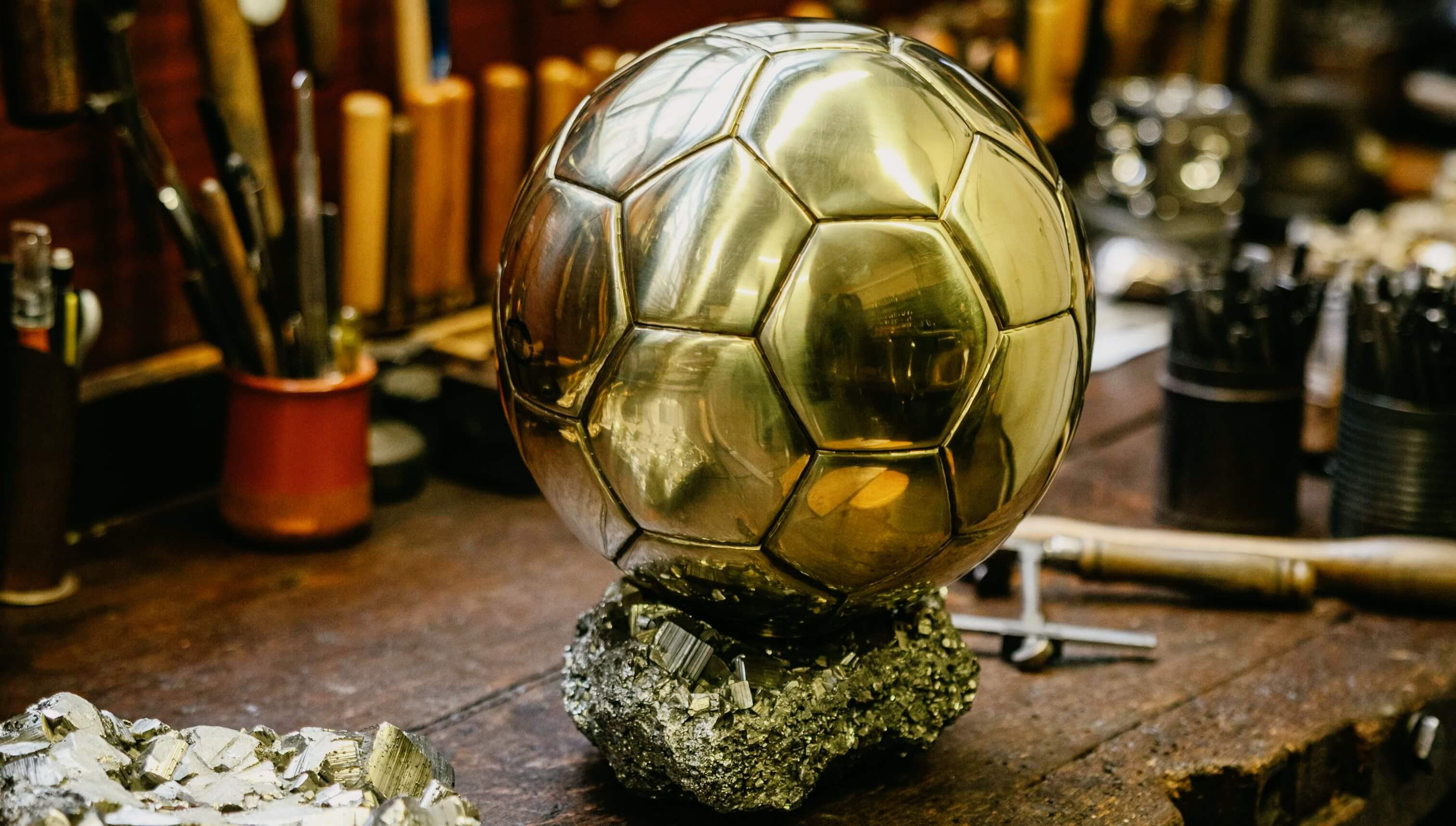
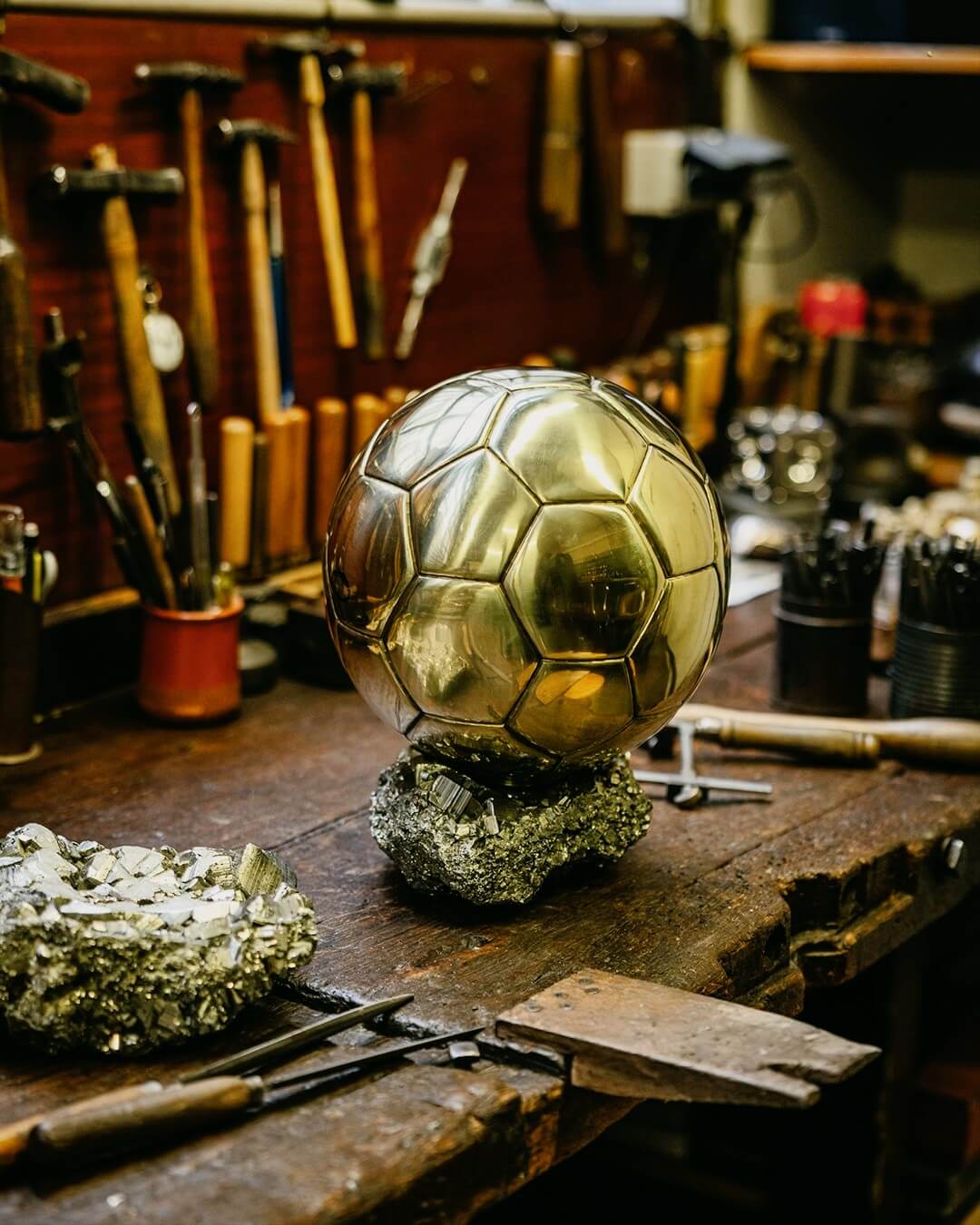
The trophy has grown considerably since its first edition. The Ballon d’Or presented to Matthews stood less than 20 centimetres tall. Since 1983 it has measured 31 centimetres high, 25.5 wide and 21 deep, and France’s national sports museum, the Musée National du Sport, puts its weight at around 15 kilograms. According to Mellerio, each trophy passes through five specialist trades in turn, taking almost 100 hours in all: silversmith, chaser, polisher, engraver and gilder. Chasing, for instance, means working relief into a metal surface with punches and a hammer.
How the Ballon d’Or Is Made
Work starts around six months before delivery, and at first the piece looks nothing like a football. The silversmith solders two brass hemispheres together, leaving an opening through which the ball will later be set into a block of pyrite.
The smooth sphere only begins to resemble a football when the chaser takes over. It is first filled with cement so the brass holds firm under the tools, then the metal is pressed along pre-drawn lines until, seam by seam, the 32 panels of a football emerge. This step alone takes around 15 hours.
After polishing, the engraver takes over, adding by hand the France Football logo, the year and, according to Mellerio, the name of the winner. Only then does the ball take on its colour, as the gilder coats it in a thin layer of gold. Underneath, it is still brass.
Why Every Ballon d’Or Has a Unique Base
The base gleams gold too, but it isn’t gold. Mellerio uses pyrite, a naturally occurring mineral known as fool’s gold because of its lustre. Unlike the ball, each base is one of a kind, according to Mellerio.
Finally, the trophy returns to the silversmith who started the work, who sets the gilded ball into its pyrite base. By the time it rests in the hands of the world’s best footballer on stage, it has already passed through many others.
