

















Forty years ago, Alex Ferguson took charge of Manchester United. He shaped several generations of football stars, saw the Premier League grow into a global entertainment industry and became an icon himself. So why does his story seem almost unthinkable today?
On 6 November 1986, Alex Ferguson, then 44, took charge of Manchester United, a club that had been waiting for a league title since 1967. The Scot arrived from Aberdeen, where he had broken the dominance of Celtic and Rangers and won the European Cup Winners’ Cup in 1983. In Manchester, he was expected to lead a great club back to the top. That he would one day become one of its best-known symbols was something hardly anyone could have imagined at the time.
Four decades on, a single gesture is enough to bring Ferguson to mind: a glance at his wristwatch. The chewing gum, the glasses, the dark coat, the taut expression on the touchline. Repeated endlessly on television, these images became part of football’s collective memory. Even those who never had much time for Manchester United know what is meant by “Fergie Time”. His 13 league titles and two Champions League trophies with United explain that presence only in part. How could one manager become so entwined with a club’s identity? And would such a career still be possible in modern football?
Alex Ferguson at Manchester United: One Manager, Several Generations
Ferguson’s early years at Manchester United barely fit the image that exists of him today. His side were inconsistent, and the success everyone hoped for failed to arrive. In December 1989, United were 15th in the league. Discontent was growing in the stands. At that point, Ferguson was a long way from being an untouchable managerial legend.
It was not until May 1990 that United won the FA Cup under him. The European Cup Winners’ Cup followed a year later. The first league title took longer still: in 1993, Ferguson ended the club’s 26-year wait. By then he had been in the job for more than six years.
It is precisely this early phase that explains the standing he later enjoyed. Ferguson was given time to impose his ideas, make changes to personnel and build long-term structures. Success was by no means guaranteed. In hindsight, his tenure looks like an inevitable success story. In reality, it could have ended much earlier.
The first trophies changed how the manager was perceived. Ferguson now stood for a team that shaped English football with a blend of young homegrown players, big personalities and pronounced self-belief. Eric Cantona became the face of the early Premier League years. Ryan Giggs, Paul Scholes, David Beckham and the Neville brothers embodied a generation that had come through the club’s own academy.
In 1999, United won the league, the FA Cup and the Champions League. In the final against Bayern Munich, both goals in the 2-1 win came in stoppage time. It was one of those moments that become permanently attached to a club. And one that reinforced the image of Ferguson as the manager of a team that never knew when it was beaten.

But Ferguson did not stop with that generation. With Cantona long retired and Beckham gone to Madrid, he built his next successful team. Wayne Rooney and Cristiano Ronaldo became its defining figures. In 2008, United won the Champions League again.
For supporters, this created different memories of the same club. Anyone who grew up with Manchester United in the early 1990s might think first of Cantona’s upturned collar. Those who lived through the turn of the millennium remember Beckham, Giggs and the final in Barcelona. For a younger generation, Ronaldo, Rooney and the triumph in Moscow take centre stage.
Players came and went, the kits changed, sponsors arrived and departed. Ferguson stayed. For almost 27 years, he was the figure who connected these different eras.
Cantona, Beckham, Ronaldo: When Football Became Pop Culture
Ferguson’s time in charge coincided with a period in which not only Manchester United but English football as a whole was transformed. When he arrived at Old Trafford in 1986, the Premier League did not yet exist. Clubs played in the Football League, and the international television market was comparatively small. Footballers were famous, but their public presence worked differently from that of today’s global brand ambassadors.
The founding of the Premier League in 1992 marked the start of a new era. Television deals, sponsors and international marketing grew ever more important. Manchester United benefited more than most. Sporting success met growing worldwide attention, and the club developed into one of the best-known brands in football.
Ferguson was not the architect of this commercial growth. The league, the club’s leadership, media companies and sponsors were just as decisive. But for decades he supplied the sporting stories and personalities that helped shape United’s global appeal.
Few players embodied the first phase of this development as clearly as Eric Cantona. The Frenchman arrived in Manchester from Leeds United in November 1992. His upturned collar, his body language and his defiant individuality made him a figure whose aura reached far beyond the pitch. Cantona was not only an outstanding footballer. He developed an aesthetic that is still associated with the 1990s and the early Premier League today.

Ferguson granted Cantona freedoms that other players did not necessarily enjoy. The Frenchman later described how much he valued the freedom his manager gave him. That freedom, however, rested on mutual trust and on the expectation that Cantona would deliver on the pitch. It runs counter to the widespread image of a man who led solely through severity and discipline. Ferguson’s authority also lay in his ability to handle very different personalities.
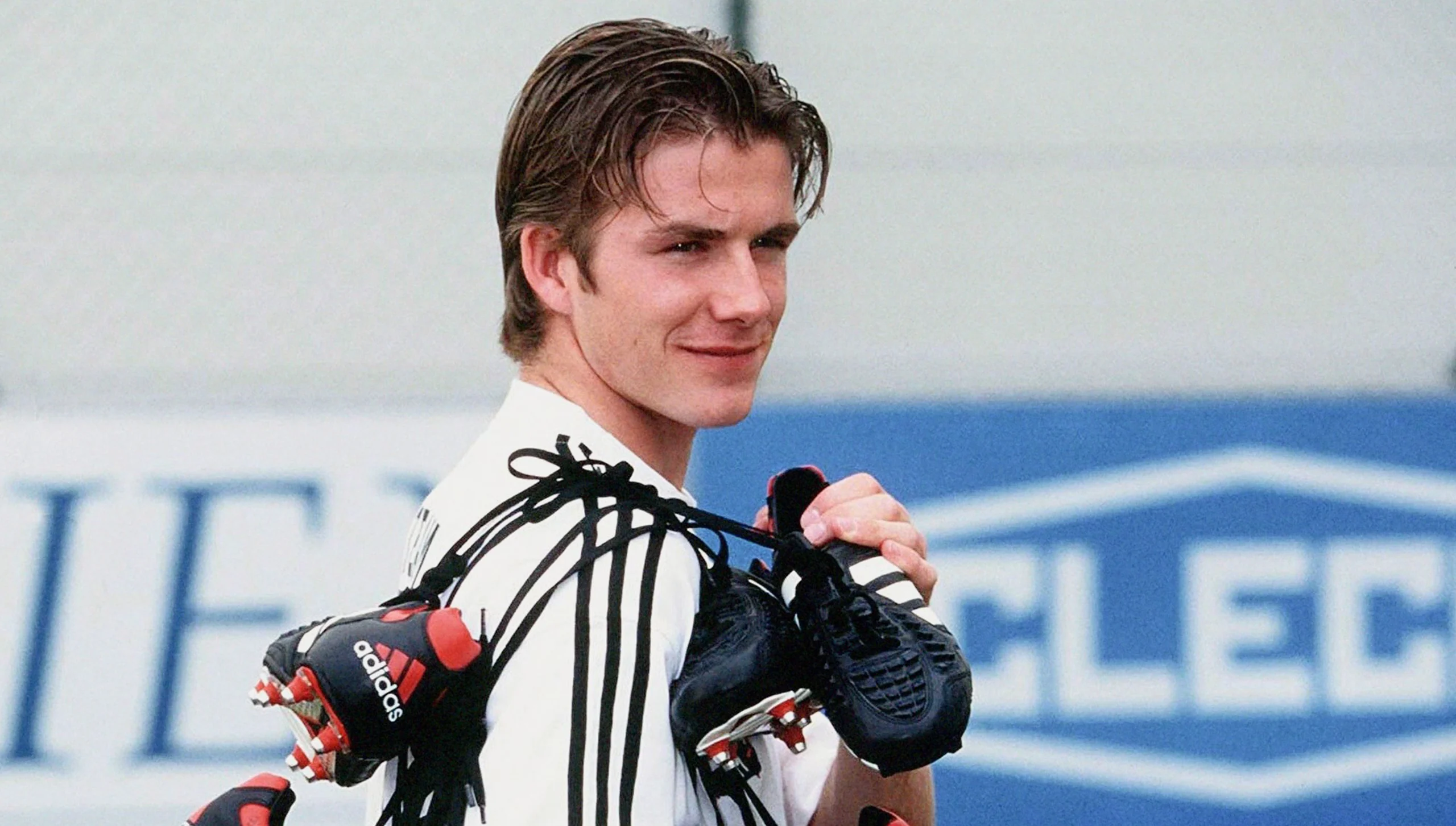
David Beckham makes football’s cultural transformation clearer still. The midfielder grew into a star at United at a time when the boundaries between sport, fashion, music and entertainment were increasingly dissolving. His haircuts were debated, his relationship with Victoria Adams made him a permanent fixture of the tabloids, and advertising campaigns carried his face around the world.
Beckham’s rise showed how a successful footballer could become an international celebrity. Ferguson played a decisive part in his development as a player. At the same time, Beckham’s growing public life was increasingly at odds with his manager’s expectations.
In 2003, Beckham left Manchester United for Real Madrid. His departure also reflected a cultural shift: football stars were no longer defined solely by their clubs. They had public identities of their own, whose reach was at times greater than that of the clubs they played for.
Finally, with Cristiano Ronaldo, Ferguson oversaw the rise of yet another generation. The Portuguese arrived in Manchester in 2003 as an 18-year-old. Six years later, he left United as the reigning FIFA World Player of the Year and one of the most famous athletes on the planet. Ronaldo later described Ferguson as a kind of father figure and stressed his importance to his personal development.

Cantona, Beckham and Ronaldo represent different phases of the modern game: the charismatic rebel, the media star and the global superstar. Ferguson worked with all three.
That is what makes his career exceptional in cultural terms, too. Ferguson did not simply manage several successful teams. Over decades, he was there as the very meaning of football stardom changed.
Fergie Time and the Hairdryer: The Making of a Myth
Some managers’ names are inseparable from a particular style of play. Others are remembered for a major trophy or an exceptional team. Ferguson left behind something more, something that can hardly be planned: a language and a set of images all his own.
“Fergie Time” is the best-known example. The term refers to United’s late goals, but also to opposing fans’ suspicion that stoppage time at Old Trafford was occasionally rather generous. What was at first also used as a mocking label became a fixture of football’s vocabulary.
One match in particular helped create the myth. On 10 April 1993, United were trailing Sheffield Wednesday. Steve Bruce equalised and then, deep into stoppage time, scored the winner as well. The victory became a key moment on the way to the club’s first league title in 26 years.
Yet the idea that United won in the dying minutes particularly often under Ferguson is only partly borne out by the numbers. An analysis by the Premier League shows that United scored 16 winning goals in the 90th minute or later during Ferguson’s tenure between 1992-93 and 2012-13. Liverpool managed 24 over the same period, Arsenal 19. Chelsea and Everton also finished ahead of United.
The figures, though, tell only part of the story. What mattered for the emergence of “Fergie Time” was seemingly less the actual frequency of late winners than the perception of them. United’s dominance, particularly dramatic moments and the constant replaying of such images created the impression that Ferguson’s teams could turn a game around at any moment.
The watch on his wrist became the fitting symbol. When Ferguson glanced at its face in the closing minutes of a game, the gesture seemed to carry a message of its own. United still had time. The opposition would have to keep sweating.
The same goes for the so-called “hairdryer treatment”. Through the stories of former players, Ferguson’s loud dressing-room outbursts became the stuff of legend. The term describes the image of the manager shouting into a player’s face from such close range and with such force that it was like standing in front of a switched-on hairdryer.

Ferguson himself claimed in 2016 that he had used the infamous hairdryer only around half a dozen times in his 27 years at United. Former players, however, described his loud team talks as experiences that very much left their mark. The hairdryer remained a central part of his public image. The stories were retold, embellished and handed down from one generation to the next.
This points to something distinctive about his cultural impact. Ferguson did not build his recognisability through a carefully staged public brand. It emerged over decades from television pictures, press conferences, players’ anecdotes and the reactions of fans. Even his clashes with journalists and rival managers helped shape his public persona.
Ferguson was never simply a figure for United fans to identify with. To supporters of rival clubs, he often embodied exactly what they disliked about Manchester United: dominance, self-assurance and the sense that the club somehow got its way when it mattered most.
That hostility, too, fed his myth. Ferguson was a figure English football spent decades grappling with.
How deeply his presence is embedded in the club’s culture became especially clear after his retirement. As late as 2023, Bruno Fernandes spoke of “Fergie Time” after a late win against Brentford. By then, Ferguson had been away from the touchline for ten years. The term still worked.
It has taken on a life of its own, independent of the man who inspired it.
Why a Second Ferguson Is Hard to Imagine
When Ferguson announced his retirement in May 2013, it was not only an extraordinarily successful managerial career that came to an end. With him went a form of authority that has become increasingly rare in elite modern football.
The traditional British manager was far more than the person responsible for team selection and training. He could set a club’s sporting direction for years, shape its youth set-up, exert decisive influence over transfers and help determine personnel decisions. Ferguson embodied this model at a time when Manchester United were simultaneously growing into a global business.
Even so, he never worked alone. Executives such as David Gill, coaches, scouts and many other staff were indispensable to United’s success. But for decades Ferguson remained the dominant sporting authority and the face of that collective effort.
Today, many of these tasks are spread across specialised departments. Sporting directors and technical directors are responsible for long-term squad planning, transfers and strategic processes. Head coaches remain central figures, but they increasingly work within organisations whose structures are not meant to depend on any one individual.
On top of that comes a different kind of public pressure. In globalised football, results, transfers and personnel decisions are commented on constantly. Social media, international fan bases and commercial expectations mean that a head coach’s work can hardly develop out of view for any length of time.
Ferguson needed more than six years to win his first league title with United. That a head coach at a club of this size would survive a comparable building phase today seems unusual, to say the least.
There are counter-examples to the notion that great managerial personalities have disappeared. At Liverpool, Jürgen Klopp became a figure fans identified with in a way that went far beyond sporting success. Pep Guardiola shaped Manchester City, in sporting and cultural terms, for ten years until he left the club in May 2026. José Mourinho, for his part, developed a public persona familiar even to people with only a passing interest in football.
It would therefore be wrong to claim that modern football can no longer produce iconic managers.
What sets Ferguson apart is the combination of several factors. He stayed for almost 27 years at one of the biggest clubs in the world. He shaped different generations of teams, lived through the globalisation of the game and at the same time became the personification of continuity at a club that changed fundamentally in economic and cultural terms.

His career began in a football world in which a manager could still wield extraordinary power. It ended in an era of global sports brands, international media markets and ever-greater commercial interests. Ferguson did not merely outlast this transformation. He became one of its most recognisable figures.
Perhaps one day there will be another manager who wins 13 league titles. Perhaps someone will stay longer at one club or achieve even greater success. But a comparable combination of longevity, influence and cultural presence would be hard to recreate.
On 23 November 2012, a few months before his retirement, Manchester United unveiled a bronze statue of Ferguson outside Old Trafford. A year earlier, the stadium’s North Stand had already been renamed after him. Such honours are usually reserved for figures whose careers have long since ended.
When Ferguson left in 2013, these tributes remained. New generations walked out onto the Old Trafford pitch, and football kept changing. Since May 2026, Michael Carrick, one of Ferguson’s former players and interim head coach since January 2026, has been Manchester United’s permanent head coach.
On 6 November 1986, Manchester United appointed a manager. Four decades on, the club pays tribute to a man who has himself become part of its identity.